Modern businesses depend heavily on digital technology. Customer information, financial records, employee accounts, cloud platforms, websites, payment systems, emails, and internal documents are often stored or managed electronically. This digital transformation has improved efficiency, but it has also increased exposure to cyber threats.
Cybercriminals do not target only large corporations. Small and medium-sized businesses can also face phishing, ransomware, account theft, data breaches, malware, and social engineering attacks. In some cases, smaller organizations can be attractive targets because they may have fewer cybersecurity resources.
This is why understanding how businesses can build a strong cybersecurity strategy has become essential.
An effective cybersecurity strategy combines technology, policies, employee awareness, risk management, access controls, backups, monitoring, and incident response. Instead of relying on one security product, businesses should create multiple layers of protection.
A strong strategy can help protect valuable information, maintain customer trust, reduce operational disruption, and improve an organization’s ability to recover when security incidents occur.
What Is a Cybersecurity Strategy?
A cybersecurity strategy is a structured plan for protecting an organization’s digital systems, networks, devices, applications, and information from cyber threats.
It defines what needs protection, which threats are most important, who is responsible for security, and what actions should be taken before, during, and after a cybersecurity incident.
A good strategy should be connected to the organization’s actual business operations.
For example, an online retailer may prioritize customer information, payment systems, e-commerce infrastructure, and account security. A manufacturing company may need to protect operational technology, industrial systems, supplier connections, and intellectual property.
Cybersecurity should therefore be based on business risk rather than treated as a collection of unrelated technical tools.
Why Businesses Need a Strong Cybersecurity Strategy
Almost every modern organization holds information that could be valuable to criminals.
This may include customer details, employee records, passwords, payment information, contracts, business plans, intellectual property, and confidential communications.
A successful cyberattack can result in financial losses, operational downtime, damaged customer relationships, regulatory consequences, and recovery expenses.
A structured cybersecurity strategy helps businesses identify these risks before incidents occur.
It also creates clear responsibilities so employees and managers know what to do when suspicious activity is detected.
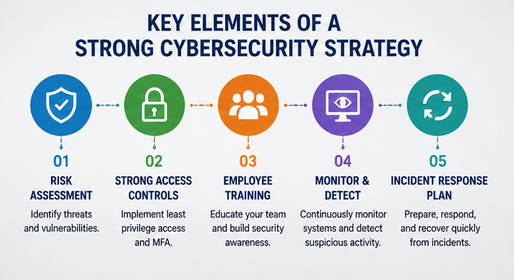
Start With a Cybersecurity Risk Assessment
The first step toward developing a strong cybersecurity strategy is understanding the organization’s current risks.
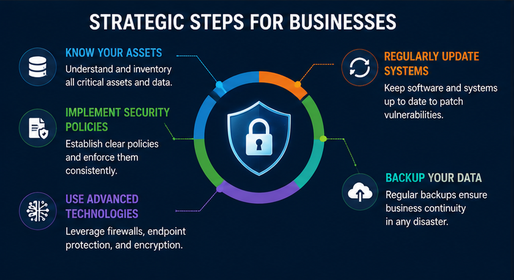
Businesses should identify their important systems, information, devices, applications, and third-party services.
They should then consider what could happen if these resources were stolen, damaged, altered, or made unavailable.
Identify Critical Business Assets
Not every digital asset has the same level of importance.
Businesses should identify which systems and information are essential for normal operations.
Critical assets may include:
- Customer databases
- Financial information
- Email accounts
- Employee records
- Cloud storage
- Websites and online stores
- Payment systems
- Business applications
- Intellectual property
- Administrative accounts
Once these assets have been identified, organizations can prioritize security resources more effectively.
Identify Possible Threats
Businesses should also consider the threats most relevant to their operations.
Common cybersecurity threats include phishing, ransomware, malware, stolen passwords, malicious insiders, business email compromise, software vulnerabilities, and attacks against third-party suppliers.
Risk assessments should be reviewed regularly because business environments and cyber threats continuously change.
Develop Clear Cybersecurity Policies
Technology alone cannot create a secure organization.
Businesses also need clear policies explaining how employees should use company devices, accounts, applications, and information.
Cybersecurity policies can establish expectations regarding passwords, remote work, software installation, data sharing, personal devices, email usage, cloud storage, and incident reporting.
Policies should be practical and understandable.
If security rules are excessively complicated, employees may ignore them or find unsafe workarounds.
The goal should be to make secure behavior part of normal business operations.
Use Strong Password Policies
Passwords remain one of the most common methods of protecting digital accounts.
Unfortunately, weak or reused passwords can make account compromise much easier.
Businesses should encourage employees to use long, unique passwords or passphrases for important accounts.
Employees should never reuse the same password across multiple business services.
Consider Password Managers
Password managers can help employees generate and store strong, unique passwords.
This reduces the temptation to use simple passwords or repeat credentials across different services.
Organizations should evaluate password-management solutions according to their security, business, and compliance requirements.
Enable Multi-Factor Authentication
Multi-factor authentication, commonly called MFA, adds another verification step beyond a password.
Depending on the system, this additional verification might involve an authentication application, hardware security key, biometric verification, or another approved method.
MFA is particularly important for:
- Email accounts
- Cloud platforms
- Financial systems
- Administrator accounts
- Remote-access services
- Customer databases
Even if an attacker obtains an employee’s password, properly configured MFA can make unauthorized access significantly more difficult.
Keep Software and Systems Updated
Outdated software can contain known security vulnerabilities.
Cybercriminals may attempt to exploit these weaknesses to access systems or install malicious software.
Businesses should establish a structured patch-management process.
Operating systems, browsers, business applications, security tools, network devices, and other important software should receive appropriate security updates.
Where practical, automatic updates can reduce the chance that important patches are forgotten.
Organizations should also identify unsupported software that no longer receives security updates and develop plans to replace it.
Train Employees About Cybersecurity
Employees are an important part of any cybersecurity strategy.
Attackers frequently target people through phishing, fraudulent phone calls, fake login pages, malicious attachments, and other social engineering techniques.
Cybersecurity awareness training can help employees recognize these threats.
Teach Employees to Recognize Phishing
Employees should understand common phishing warning signs, including unexpected attachments, unusual payment requests, suspicious links, urgent account warnings, and requests for passwords or verification codes.
However, businesses should also recognize that sophisticated phishing messages may look professional and contain few obvious mistakes.
Employees should therefore be encouraged to verify unusual requests through trusted communication channels.
Create a Positive Reporting Culture
Employees should feel comfortable reporting suspicious activity.
If someone accidentally clicks a suspicious link, early reporting can allow security teams to respond more quickly.
A culture that automatically punishes every mistake may discourage employees from reporting incidents.
Cybersecurity training should focus on awareness, responsibility, and rapid communication.
Apply the Principle of Least Privilege
Not every employee needs access to every system.
The principle of least privilege means users should receive only the access required to perform their jobs.
For example, an employee working in marketing may not need access to payroll information or financial administration systems.
Restricting unnecessary access can reduce the potential impact of compromised accounts.
Businesses should regularly review user permissions, especially when employees change roles or leave the organization.
Secure Administrator Accounts
Administrator accounts can provide extensive control over systems and applications.
If an attacker compromises one of these accounts, the consequences can be serious.
Businesses should limit administrative privileges to employees who genuinely require them.
Administrator accounts should use strong authentication and should generally not be used for routine activities when separate standard accounts are appropriate.
Monitoring privileged activity can also help organizations identify unusual behavior.
Protect Business Data
Information is one of the most valuable resources many businesses possess.
Organizations should understand what information they collect, why they collect it, where it is stored, and who can access it.
Sensitive information should receive stronger protection.
Use Encryption
Encryption converts readable information into a protected form that generally requires the correct cryptographic key to access.
Businesses can use encryption to protect appropriate sensitive information while it is stored and when it is transmitted.
Encryption is particularly important for laptops, mobile devices, financial information, customer records, and confidential communications.
However, encryption must be implemented correctly and supported by appropriate key-management practices.
Create a Reliable Backup Strategy
Backups are essential for business continuity.
Hardware failure, ransomware, accidental deletion, natural disasters, or other incidents can make important information unavailable.
Businesses should maintain regular backups of critical information.
A commonly discussed approach is the 3-2-1 backup strategy: maintain three copies of important data, use two different types of storage, and keep at least one copy separated from the primary environment.
The exact backup approach should reflect the organization’s size and requirements.
Test Your Backups
Creating backups is not enough.
Businesses should periodically test whether important information can actually be restored.
A backup that cannot be recovered during an emergency provides little value.
Organizations should define recovery priorities and understand how quickly essential systems need to return to operation.
Secure Business Networks
Network security remains an important part of cybersecurity.
Organizations should use appropriate firewalls, secure configurations, encrypted connections, and access controls.
Wireless networks should use modern security protections and strong credentials.
Guest networks should generally be separated from systems containing sensitive business information.
Larger organizations may also benefit from network segmentation, which separates important systems into different security zones.
Segmentation can make it more difficult for attackers to move freely through an organization’s infrastructure after compromising one system.
Protect Remote Workers
Remote and hybrid work have expanded the traditional business security perimeter.
Employees may access company information from homes, hotels, shared workspaces, or other locations.
Organizations should establish clear remote-work security requirements.
Company devices should be appropriately protected, updated, and monitored according to business needs.
Employees should avoid exposing confidential information through unsecured devices or networks.
Secure remote-access technologies and strong authentication can provide additional protection.
Strengthen Cloud Security
Many businesses now depend on cloud platforms for email, file storage, collaboration, customer management, and business applications.
Moving information to the cloud does not eliminate the organization’s cybersecurity responsibilities.
Businesses must still manage account security, permissions, configuration, information protection, and monitoring.
Review Cloud Permissions
Misconfigured access permissions can unintentionally expose sensitive information.
Organizations should regularly review who has access to cloud resources and remove permissions that are no longer required.
MFA should also be enabled for important cloud accounts wherever supported.
Secure Mobile Devices
Smartphones and tablets often contain or provide access to business information.
A lost or compromised device could expose emails, documents, authentication applications, and customer information.
Organizations should require appropriate screen locks, software updates, and secure application practices.
Depending on business requirements, mobile device management solutions can help organizations enforce security policies and manage company devices remotely.
Manage Third-Party Cybersecurity Risks
Businesses rarely operate completely independently.
They may depend on software vendors, payment processors, cloud providers, marketing platforms, contractors, logistics companies, and other external organizations.
These relationships can introduce additional cybersecurity risks.
A supplier with access to company systems or information could potentially become an indirect route for attackers.
Organizations should therefore evaluate important vendors before granting access to sensitive resources.
Contracts may also define appropriate security responsibilities, notification requirements, and data-handling expectations.
Monitor Systems for Suspicious Activity
Cybersecurity should include both prevention and detection.
No organization can guarantee that every attack will be blocked.
Businesses therefore need ways to identify unusual activity quickly.
Security monitoring may include reviewing authentication attempts, account activity, endpoint alerts, network events, and changes to critical systems.
Larger organizations may use specialized security information and event management systems to centralize security monitoring.
Small businesses can still benefit from alerts provided by operating systems, cloud services, email platforms, and security products.
Develop an Incident Response Plan
Businesses should assume that cybersecurity incidents are possible despite strong preventive measures.
An incident response plan explains what should happen when an attack is detected.
The plan should identify responsibilities and communication procedures.
Basic Incident Response Stages
A structured response typically includes preparation, detection, containment, investigation, recovery, and post-incident improvement.
For example, if an employee account is compromised, the organization may need to disable access, reset credentials, review activity, determine what information was affected, restore normal operations, and identify how the compromise occurred.
Having these procedures established before an emergency can significantly improve response speed.
Create a Business Continuity Plan
Cybersecurity incidents can interrupt business operations even when no information is permanently lost.
Organizations should understand which services are essential and how long they can remain unavailable.
A business continuity plan can establish alternative procedures for operating during disruptions.
This may involve backup communication channels, recovery systems, emergency contacts, alternative suppliers, or manual processes.
Cybersecurity and business continuity should therefore work together.
Consider a Zero Trust Approach
Traditional cybersecurity sometimes relied heavily on protecting the organization’s network perimeter.
Modern environments are more complex because employees use cloud services, mobile devices, remote connections, and third-party platforms.
Zero Trust follows the principle that access should be appropriately verified rather than automatically trusted simply because someone is inside a network.
Organizations can implement Zero Trust concepts through strong identity verification, least-privilege access, device security, segmentation, and continuous evaluation.
Businesses do not necessarily need to implement every component at once. A gradual approach can still strengthen security.
Use Cybersecurity Frameworks
Established cybersecurity frameworks can help businesses structure their security programs.
Instead of creating every security process from the beginning, organizations can use recognized frameworks as guidance.
These frameworks generally help businesses identify assets, understand risks, establish protections, detect incidents, respond effectively, and recover operations.
Businesses should select approaches appropriate for their industry, size, legal environment, and risk level.
Cybersecurity for Small Businesses
Small businesses may not have large cybersecurity budgets or dedicated security departments.
However, strong cybersecurity does not always require expensive infrastructure.
Smaller organizations can begin with essential controls such as MFA, software updates, employee training, backups, password managers, restricted permissions, endpoint protection, and secure cloud configurations.
Cybersecurity investments should focus first on the risks that could cause the greatest business damage.
The Role of Leadership in Cybersecurity
Cybersecurity should not be considered solely an IT department responsibility.
Business leaders influence budgets, priorities, company culture, and risk management.
Senior management should understand the organization’s major cyber risks and ensure that appropriate resources are available.
Leaders should also participate in incident-response planning.
When cybersecurity becomes part of strategic business planning, organizations can make more informed decisions about technology and risk.
Common Cybersecurity Strategy Mistakes
Businesses can weaken their security programs through several common mistakes.
One is assuming that installing antivirus software solves every cybersecurity problem.
Another is focusing exclusively on technology while ignoring employees, policies, vendors, and business processes.
Organizations may also create backups without testing them, provide employees with unnecessary access, delay security updates, or fail to develop incident-response procedures.
Another major mistake is treating cybersecurity as a one-time project.
Security strategies must evolve because technology, employees, business operations, and cyber threats continuously change.
Measuring Cybersecurity Performance
Businesses should evaluate whether their cybersecurity strategy is actually working.
Useful measurements may include how quickly critical updates are installed, how many important accounts have MFA enabled, how rapidly suspicious incidents are reported, and whether backups can be restored successfully.
Organizations can also track employee security training completion and review how quickly access is removed when staff members leave.
The purpose of cybersecurity metrics should be to identify weaknesses and guide improvements rather than simply generate reports.
Artificial Intelligence and the Future of Business Cybersecurity
Artificial intelligence is changing the cybersecurity landscape.
Businesses can use AI-assisted security technologies to analyze large amounts of activity, identify suspicious patterns, prioritize alerts, and automate certain repetitive security tasks.
However, attackers can also use AI to improve scams.
AI-generated phishing messages, synthetic voices, fake images, and deepfake videos can make social engineering more convincing.
Organizations may therefore need stronger verification procedures for unusual financial or confidential requests.
A voice message or video call alone may not always be sufficient proof of identity.
Make Cybersecurity an Ongoing Process
A strong cybersecurity strategy cannot remain unchanged for years.
Businesses introduce new applications, hire employees, adopt cloud services, change suppliers, and expand into new markets.
Each change can introduce new security requirements.
Organizations should periodically conduct risk assessments, review access permissions, test incident-response procedures, evaluate vendors, update policies, and provide employee training.
Continuous improvement is one of the most important principles of effective cybersecurity.
Conclusion
Understanding how businesses can build a strong cybersecurity strategy has become essential in today’s digital economy.
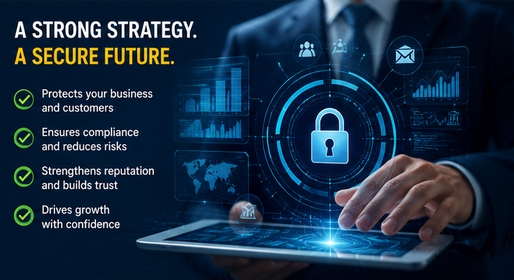
A strong strategy begins by identifying important assets and understanding the risks that could affect them. Businesses can then create multiple layers of protection using strong authentication, employee training, software updates, secure configurations, backups, access controls, encryption, network security, cloud protection, and continuous monitoring.
Organizations should also prepare for the possibility that preventive measures may fail. Incident-response and business-continuity plans can help reduce disruption and improve recovery.
Most importantly, cybersecurity should not be treated as a single software product or a one-time IT project. It is an ongoing business responsibility involving employees, technology, leadership, suppliers, policies, and processes.
Companies that make cybersecurity part of their overall risk-management strategy are better positioned to protect information, maintain customer confidence, support business continuity, and adapt to future digital threats.